INTEGRASI KARYA SASTRA DALAM LKPD PBL UNTUK MENINGKATKAN KEMAMPUAN BERPIKIR KRITIS DAN GLOBAL- MINDED LEARNERS
DOI:
https://doi.org/10.22460/semantik.v15i1.p1-12Keywords:
Problem-Based Learning, literary works, Student Worksheets, critical thinking, global literacy, RPJMN 2025–2029Abstract
Educational transformation is a strategic imperative in the era of globalization and the Fourth Industrial Revolution, which demands adaptive and high-quality human resources. This study aimed to develop and evaluate Problem-Based Learning based Student integrated with English literary works to enhance students’ critical thinking skills and global-mindedness. Employing a mixed-methods Research and Development design, the study was conducted at SMK Negeri 1 Tanjung Pura with 120 student participants. Data were collected through tests, questionnaires, observations, interviews, and documentation, and analyzed using quantitative and qualitative techniques. Repeated-measures ANOVA indicated a significant improvement in learning outcomes, with mean scores increasing from the pre-test (M = 75.88, SD = 5.12) to the post-test (M = 94.52, SD = 3.76), F(1,119) = 140.70, p < 0.001, and a large effect size (Partial η² = 0.542). The intervention accounted for over 54% of the variance in learning outcomes, demonstrating substantial effectiveness. Qualitative findings revealed enhanced student engagement, critical reflection, and argumentative skills, while teachers benefited from innovative instructional materials. The integration of literary works provided authentic contexts that fostered cultural empathy, global literacy, and reflective learning. Overall, this study contributes to the 2025–2029 RPJMN by supporting the development of globally competitive human resources.
References
Ali, N. H., & Razali, A. B. (2021). Literature in the ESL classroom: Fostering critical thinking
and intercultural awareness. Asian Journal of English Language Studies, 9(2), 45–60.
Anggaeni, D. M., Prahani, B. K., Suprapto, N., Nofiyah, N., & Jatmiko, B. (2023). Systematic
review of problem-based learning research in fostering critical thinking skills. Thinking Skills and Creativity, 49.
Asia Society. (2020). Educating for global competence: Preparing our youth to engage the world.
Asia Society Center for Global Education.
Avisa, N., Wachyudin, K., & Rahmawati, M. (2024). Peran karya sastra dalam mengembangkan
keterampilan berpikir kritis siswa dalam pengajaran bahasa Inggris. Jurnal Pendidikan Tembusai, 8(2).
Bappenas. (2024). Rancangan teknokratik RPJMN 2025–2029.
Borg, R. W., & Gall, M. D. (2007). Education research and introduction (8th ed.). Pearson
Education.
Budiyatno, Suseno, N., & Aththibby, A. R. (2024). Pengembangan LKPD berbasis STEM dengan
pendekatan problem-based learning terhadap keterampilan proses sains dan kemampuan berpikir kritis pada pembelajaran IPA. PENDIPA Journal of Science Education, 8(3).
Barrows, H. S., & DeSimone, C. (2023). Problem-based learning: Goals for learning and
strategies for knowledge construction. Educational Psychologist, 58(1), 1–16.
Creswell, J. W., & Creswell, J. D. (2017). Research design: Qualitative, quantitative, and mixed
methods approaches. Sage Publications.
Facione, P. A. (2020). Critical thinking: What it is and why it counts. Insight Assessment. Hmelo
Silver.
Fadhilah, M., Miaz, Y., Fitria, Y., & Zen, Z. (2023). Problem-based learning model and motivation on
students’ critical thinking ability in natural and social science learning. IRJE Indonesian Research Journal in Education, 7(2).
Fraenkel, J. R., Wallen, N. E., & Hyun, H. H. (2019). How to design and evaluate research in
education (10th ed.). McGraw-Hill Education.
Hmelo-Silver, C. E., Barrows, H. S., & DeSimone, C. (2023). Problem-based learning: Goals for
learning and strategies for knowledge construction. Educational Psychologist, 58(1), 1–16.
Hung, W. (2022). Problem-based learning: A learning environment for enhancing learning transfer.
Educational Technology Research and Development, 70(1), 181–200.
Kartini, S. M. S., Widiarti, N. K., & Pujawan, I. G. N. (2023). The effect of problem-based blended
learning towards students’ critical and creative thinking skills. JMKSP: Jurnal Manajemen, Kepemimpinan, dan Supervisi Pendidikan, 8(1).
Kim, Y., & Kwon, J. (2023). Critical global citizenship education for transnational youth: The role of
critical thinking. Teaching and Teacher Education, 119.
Meityasti, I., & Wijaya, A. (2022). Pengembangan LKPD model PBL berbasis STEM dengan
menggunakan aplikasi Desmos untuk meningkatkan kemampuan berpikir kritis. Jurnal Pedagogi Matematika, 8(1).
Milal, A. D., Kusumajanti, W., Sa’adah, S. I., & Zainiati, H. S. (2022). Students' problems in the
instruction of English literature in the EFL context. Journal of Literature and Language Teaching, 13(2).
Nuraini, D., Lestari, R., & Maulana, H. (2022). Integrating literature into PBL worksheets: Enhancing
students’ critical thinking and engagement. Journal of Language and Education Research, 5(3), 201–215.
OECD. (2024). Global trends in government innovation 2024: Fostering human-centred public
services. OECD Observatory of Public Sector Innovation.
Saragih, A. L. R., & Hasratuddin. (2024). Pengembangan LKPD berbasis PBL untuk
meningkatkan kemampuan komunikasi matematis siswa SMP Negeri 1 Tanjung Morawa. Konstanta: Jurnal Matematika dan Ilmu Pengetahuan Alam, 2(3).
Sugiyono. (2022). Metode penelitian pendidikan: Pendekatan kuantitatif, kualitatif, dan R&D.
Alfabeta.
UNESCO. (2023). Media and information literacy. UNESCO Digital Library.
Waghid, Z. (2024). Cultivating critical thinking, social justice awareness and empathy among
pre-service teachers through online discussions on global citizenship education. Journal of Creative
Communications, 19(1).
Downloads
Published
Issue
Section
License

This work is licensed under a Creative Commons Attribution-ShareAlike 4.0 International License.
The author is responsible for acquiring the permission(s) to reproduce any copyrighted figures, tables, data, or text that are being used in the submitted paper. Authors should note that text quotations of more than 250 words from a published or copyrighted work will require a grant of permission from the original publisher to reprint. The written permission letter(s) must be submitted together with the manuscript.
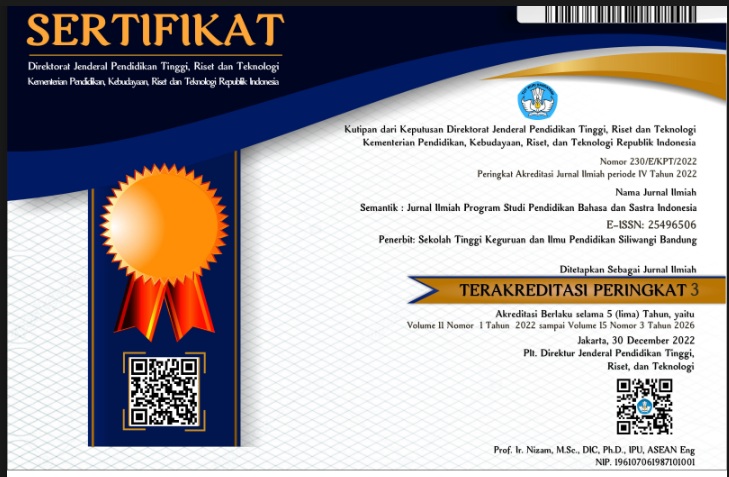 Accreditation Decree