KETERAMPILAN BERBICARA BAHASA INDONESIA BAKU PADA ANAK USIA DINI: ANALISIS PSIKOLINGUISTIK
DOI:
https://doi.org/10.22460/semantik.v15i1.p55-68Keywords:
Language acquisition, psycholinguistics, standard Indonesian, early childhoodAbstract
This study focuses on the ability of children aged 4–6 years to use standard Indonesian through a psycholinguistic perspective. The inquiry is significant because early mastery of the standard language serves as a strong foundation for children’s academic, social, and communicative development at later stages. The research employed a qualitative descriptive method by analyzing six video recordings of spontaneous conversations involving two children. The data were transcribed and then classified into three main aspects: phonology, syntax, and semantics. The findings indicate that the children were able to articulate vowels and consonants accurately, construct declarative, interrogative, and imperative sentences with appropriate structures, and use standard vocabulary within relevant conversational contexts. These results suggest that children at this age already possess relatively advanced language skills. Internal factors such as cognitive, physiological, and biological readiness interact with external factors such as parenting styles, social environment, and exposure to digital media, thereby shaping children’s linguistic competence. Thus, language acquisition is not merely imitation but an active process of selective construction based on the input received. This study emphasizes the importance of consistent linguistic stimulation from early childhood as a foundation for mastering the standard language as well as preparing children for formal education.
References
Alfin, J., Rosyidi, Z., & Abdillah, H. (2018). Pengembangan Kemampuan Berbicara Bahasa Indonesia Anak Umur 5-6 Tahun Melalui Metode Bercerita Dengan Media Televisi Bergambar. In JPUD - Jurnal Pendidikan Usia Dini (Vol. 12, Issue 2, pp. 271–280). https://doi.org/10.21009/jpud.122.08
Astuti, R., Nugroho, A., & Pramudita, Y. (2024). Metode penelitian kualitatif dalam pendidikan bahasa. Yogyakarta: Pustaka Pelajar.
Brown, H.D. 1980. Principles of Language Teaching and Learning. New Jersey: Prentice Hall.
Chomsky, N. (1965). Aspects of the Theory of Syntax. The MIT Press.
Dhieni, N., Fridani, L., Muis, A., & Yarmi, G. (2014). Metode Pengembangan Bahasa. In Hakikat Perkembangan Bahasa Anak (pp. 1–28). Universitas Terbuka. http://repository.ut.ac.id/4695
Doherty, J., & Hughes, M. (2014). Child Development: Theory and Practice (0-11). Pearson Education Limited.
Gleason, Jean Berko, author.; Ratner, N. B. (2017). The development of language (Ninth edit). Boston : Pearson.
Harras, K. A., & Bachari, A. D. (2009). Psikolinguistik Dasar-dasar. UPI Press.
Jamilah, J. (2017). Penggunaan Bahasa Baku dalam Karya Ilmiah Mahasiswa. Tarbiyah: Jurnal Ilmiah Kependidikan, 6(2). https://doi.org/10.18592/tarbiyah.v6i2.1603
Kuntarto, E. (2018). Bahasa Indonesia: Modul Kuliah untuk Perguruan Tinggi. Akbid Surabaya.
Lestari, P. S., & Setiawan, H. (2022). Gangguan Mekanisme Berbicara Pada Anak Usia 4 Tahun: Kajian Psikolinguistik. Jurnal Pendidikan Tambusai , 6(2), 9609–9614.
Livingstone, S. (2023). Digital play on children ’ s terms : A child rights approach to designing digital experiences. https://doi.org/10.1177/14614448231196579
Masykouri, A. (2011). Mengasah Kemampuan Berbahasa di Usia 0-2 Tahun. Direktorat Pembinaan Pendidikan Anak Usia Dini, Direktorat Jenderal Pendidikan Anak Usia Dini Nonformal dan Informal, Kementerian Pendidikan Nasional.
Mar'at, S. (2009). Psikolinguistik: Suatu Pengantar. Bandung: PT RefikaAditama
Miles, M. B., Huberman, A. M., & Saldaña, J. (2014). Qualitative Data Analysis: A Methods Sourcebook (3rd ed.). Sage Publications Ltd.
Patimah. (2024). Analisis Produksi Buku Ujaran pada Anak: Studi Kasus Selebgram Cilik Shabira Alula. Metabasa: Jurnal Bahasa, Sastra Dan Pembelajaran, 6(1). https://doi.org/10.37058/mbsi.v6i1.12234
Patton, M. Q. (2002). Qualitative Research and Evaluation Methods (3rd ed.). Sage Publications.
Riska, R., Azis, A., & Tarman, T. (2024). Pengaruh Lingkungan Keluarga Dan Lingkungan Sosial Terhadap Kemampuan Berbicara Siswa Sekolah Dasar. Jurnal Riset Dan Inovasi Pembelajaran, 4(1), 389–401. https://doi.org/10.51574/jrip.v4i1.1405
Santoso, A. (2020). Pengaruh Faktor Internal dan Eksternal dalam Pemerolehan Bahasa Anak Usia Dini. Jurnal Psikolinguistik Terapan
Saddhono, K., & st Y, S. (2012). Meningkatkan keterampilan berbahasa indonesia (teori dan aplikasi). Bandung: Karya Putra Darwati
Sudaryanto, A. (2015). Metode dan Aneka Teknik Analisis Bahasa. LP3S.
Suharti, S., Khusnah, W. D., Sri Ningsih, S., Shiddiq, J., Saputra, N., Kuswoyo, H., Jalal, N. M., Dhari, P. W., Susanti, R., & Purba, J. H. (2021). Kajian Psikolinguistik. Yayasan Penerbit Muhammad Zaini.
Sujarweni, Wiratna. (2014). Metodologi Penelitian. Pustaka Baru Press
Downloads
Published
Issue
Section
License

This work is licensed under a Creative Commons Attribution-ShareAlike 4.0 International License.
The author is responsible for acquiring the permission(s) to reproduce any copyrighted figures, tables, data, or text that are being used in the submitted paper. Authors should note that text quotations of more than 250 words from a published or copyrighted work will require a grant of permission from the original publisher to reprint. The written permission letter(s) must be submitted together with the manuscript.
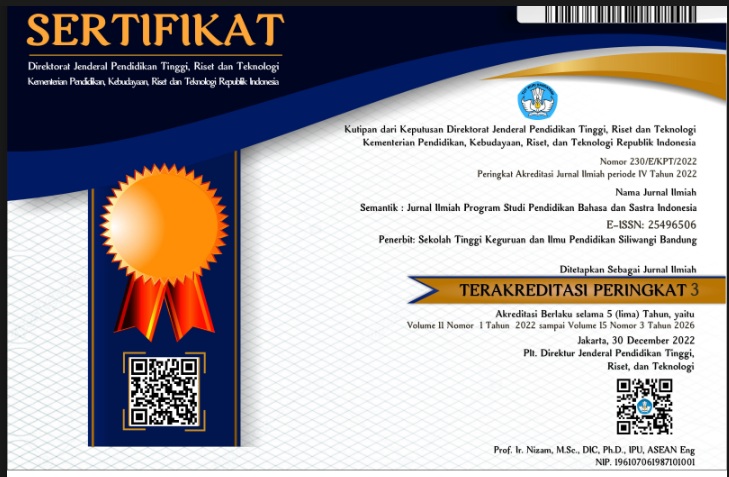 Accreditation Decree