METODE SOKRATIK BERBASIS DIALOG REFLEKTIF DAN ISU KONTEKSTUAL DALAM PEMBELAJARAN BERBICARA ARGUMENTATIF
DOI:
https://doi.org/10.22460/semantik.v15i1.p81-92Keywords:
Argumentative, Reflective Dialogue, Socratic, Critical ThinkingAbstract
This study aims to evaluate the effectiveness of the Socratic method, which is based on reflective dialogue and issue context, in improving the argumentative speaking skills of ninth-grade junior high school students. The research methodology used was a quasi-experimental study with an unequal control group design, involving two classes: one as an experimental class implementing the Socratic method, and the other as a control class receiving traditional teaching methods. Data collection tools used included a speaking test, a rubric for assessment, and observations. The findings of this study showed an increase in the average post-test score in the experimental class, which reached 78.25, significantly higher than the control class, which was only 53.50. The Wilcoxon test yielded a significance value of 0.000 < 0.05, indicating a significant difference between the conditions before and after the treatment. Furthermore, the N-Gain score for the experimental class was 0.58 (in the moderately effective category), while the control class only achieved 0.25 (in the ineffective category). Thus, the Socratic method has proven successful in improving students' argumentative speaking skills.
References
Amelia, L. D. (2025). The effect of argument-driven inquiry (ADI) model on students’ critical thinking skills in writing argumentation texts. KEMBARA: Jurnal Keilmuan Bahasa, Sastra, dan Pengajarannya, 11(1), 294–307.
Emilia, R. (2010) Pendekatan genre dalam pembelajaran bahasa: Petunjuk untuk guru. Bandung: Rizqi Press.
Kemendikbud. (2022). Profil Pelajar Pancasila: Panduan Implementasi Kurikulum Merdeka. Jakarta: Kemendikbud.
Kemendikbudristek BSKAP. (2022). Keputusan Kepala Badan Standar, Kurikulum, dan Asesmen Pendidikan Kementerian Pendidikan, Kebudayaan, Riset, dan Teknologi Nomor 009/H/KR/2022 Tentang Dimensi, Elemen, dan Sebelemen Profil Pelajar Pancasila Pada Kurikulum Merdeka. Kemendikbudristek BSKAP RI.
Kementerian Pendidikan, Kebudayaan, Riset, dan Teknologi. (2022). Panduan Pembelajaran dan Asesmen Kurikulum Merdeka. Jakarta: Kemendikbudristek.
Knapp & M. Watkins. (2013). Genre, Text, Grammar: Technologies for Teaching and Assessing Writing, Sydney: University of New South Wales Press.
Lestari I. (2022). Dialog reflektif dalam pembelajaran IPS untuk penguatan literasi kritis. Jurnal Cakrawala Pendidikan, 41(3). 455-468.
Maryanto. (2013). Bahasa Indonesia: Ekspresi Diri dan Akademik Kelas X, Jakarta: Kementerian Pendidikan dan Kebudayaan.
Nelson J. (2018). Socratic Method and Critical Philosophy. Paris: OECD Publishing.
Paul, R., & Elder L. (2014). Critical Thinking: Tools for Taking Charge of Your Learning and Your Life. New York: Pearson.
Pitrianti, S., Nofrahadi, N., Ambasari, N., & Satria, D. (2025). Pengembangan instrumen evaluasi membaca kritis teks di Kurikulum Merdeka. Fon: Jurnal Pendidikan Bahasa dan Sastra Indonesia, 21(1), 284–297.
Pulungan H.K,, Anshori D., S. Sumiyadi, & Mulyati Y. (2025). The role of debate learning in improving students’ critical and argumentative thinking skills: A needs analysis. KEMBARA: Jurnal Keilmuan Bahasa, Sastra, dan Pengajarannya. 11(1):60–75.
Rahman A. (2021). Penerapan Metode Sokratik untuk Meningkatkan Kemampuan Berpikir Kritis Mahasiswa. Jurnal Pendidikan Humaniora, 9 (1):56-63.
Sugiyono .(2017). Metode Penelitian Pendidikan: Pendekatan Kuantitatif, Kualitatif, dan R&D. Bandung: Alfabeta.
W. Creswell & Guetterman, T. C.(2019). Educational research: planning, conducting, and evaluating quantitative and qualitative research, 6th ed., Boston: Pearson.
Downloads
Published
Issue
Section
License

This work is licensed under a Creative Commons Attribution-ShareAlike 4.0 International License.
The author is responsible for acquiring the permission(s) to reproduce any copyrighted figures, tables, data, or text that are being used in the submitted paper. Authors should note that text quotations of more than 250 words from a published or copyrighted work will require a grant of permission from the original publisher to reprint. The written permission letter(s) must be submitted together with the manuscript.
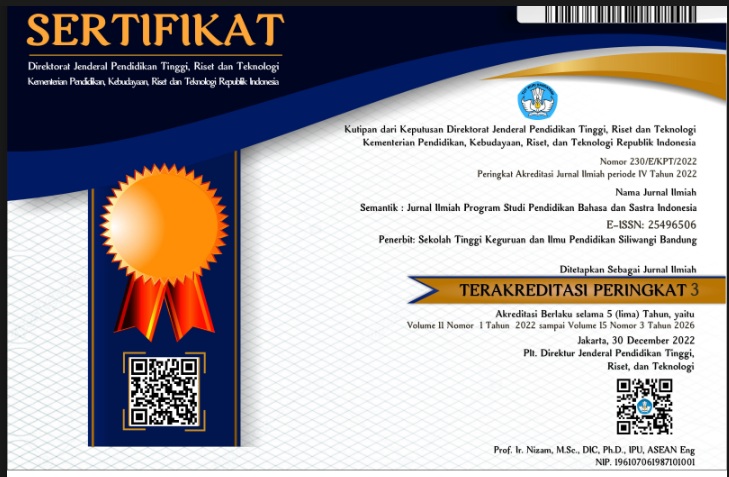 Accreditation Decree