
Cultural heritage as a mathematical context: Interpretation of set theory in spatial layout of Prambanan temple
##plugins.themes.bootstrap3.article.sidebar##
##plugins.themes.bootstrap3.article.main##
Abstract
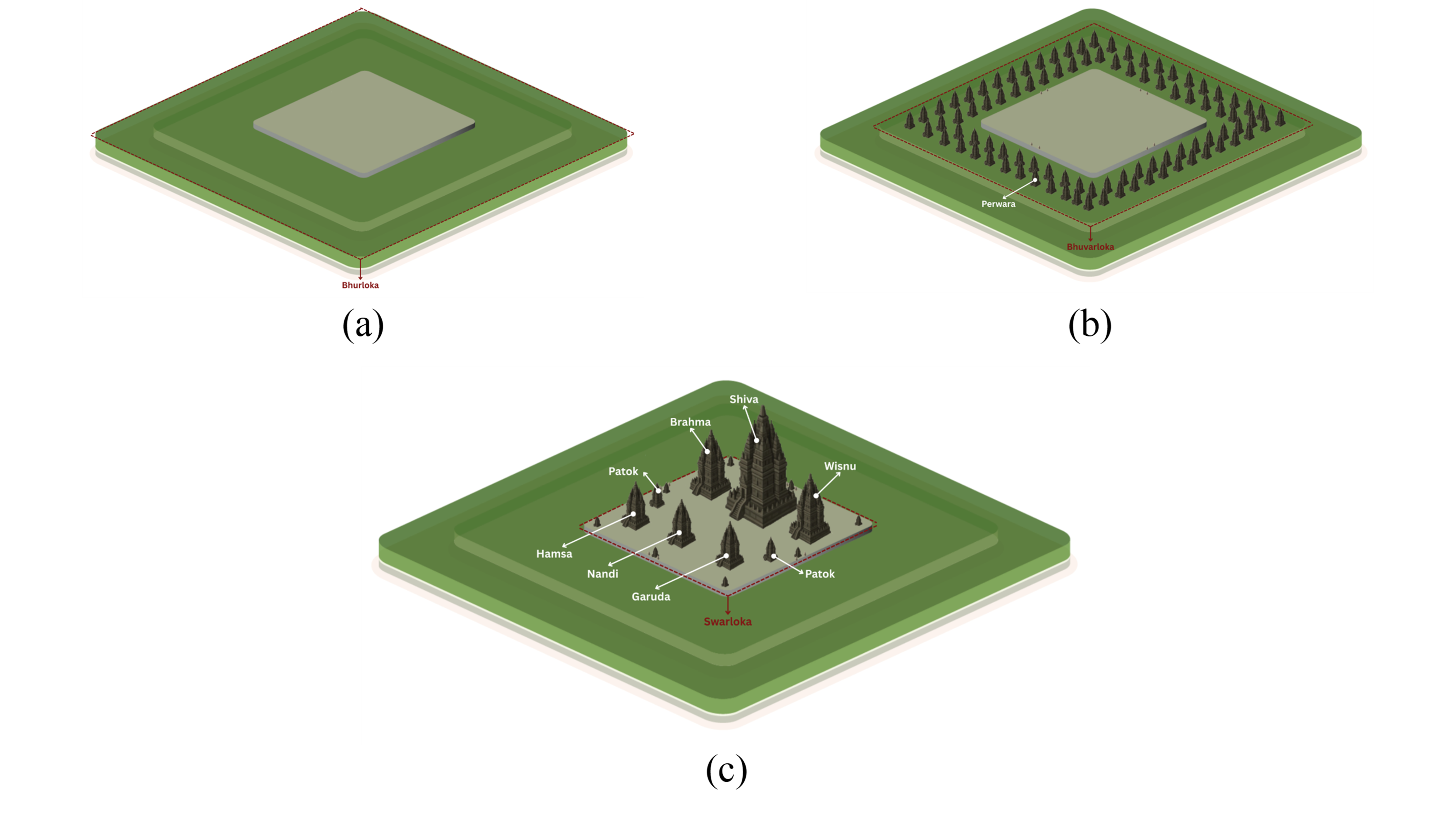
Mathematics is often perceived as culturally neutral and detached from its social and historical foundations, leading to the neglect of cultural heritage rich in mathematical ideas. This study investigates how the concept of sets is reflected in the spatial layout of the Prambanan Temple Complex through an ethnomathematics perspective. By uncovering these embedded structures, the research demonstrates the potential of cultural heritage as a meaningful context for mathematics education, promoting both conceptual understanding and appreciation of cultural identity. Adopting an ethnomathematics perspective, this study employs ethnographic methods to analyze the spatial layout of the 9th-century Prambanan Temple. The investigation focuses on identifying mathematical principles within the temple’s spatial classification system, particularly in relation to grouping, membership, and separation across the hierarchical zones of Bhurloka, Bhuvarloka, and Swarloka. The analysis reveals that ancient Javanese society implicitly can be interpreted as set-theoretical structures in the spatial layout of Prambanan Temple. The hierarchical spatial divisions demonstrate systematic applications of grouping, inclusion, and exclusion principles, reflecting mathematical thought embedded in cultural practices. These insights suggest that cultural artifacts such as temple architecture can be modeled through mathematical frameworks and provide authentic contexts for mathematics learning. This study contributes to the field of multicultural mathematics education by illustrating how cultural heritage can serve as a valuable resource in teaching through the Ethno-Realistic Mathematics Education approach. Situating mathematical concepts in culturally relevant contexts deepens conceptual understanding and strengthens cultural identity, offering practical implications for educators and curriculum developers seeking to embed multicultural perspectives in mathematics education.
##plugins.themes.bootstrap3.article.details##

This work is licensed under a Creative Commons Attribution-ShareAlike 4.0 International License.
The author is responsible for acquiring the permission(s) to reproduce any copyrighted figures, tables, data, or text that are being used in the submitted paper. Authors should note that text quotations of more than 250 words from a published or copyrighted work will require grant of permission from the original publisher to reprint. The written permission letter(s) must be submitted together with the manuscript.References
Bailly, F., & Longo, G. (2011). Mathematics and the natural sciences: The physical singularity of life. World Scientific.
Barton, B. (1996). Making sense of ethnomathematics: Ethnomathematics is making sense. Educational Studies in Mathematics, 31(1), 201–233. https://doi.org/10.1007/bf00143932
Bishop, A. J. (1991). Mathematical enculturation: A cultural perspective on mathematics education. Springer. https://doi.org/10.1007/978-94-009-2657-8
Borba, M. C. (1990). Ethnomathematics and education. For the learning of Mathematics, 10(1), 39–43.
Campbell, S. (2018). Javanese culture and the meanings of locality: Studies on the arts, urbanism, polity, and society, by Bagoes Wiryomartono. Asian Studies Review, 42(3), 563–564. https://doi.org/10.1080/10357823.2018.1436854
Dabbour, L. M. (2012). Geometric proportions: The underlying structure of design process for Islamic geometric patterns. Frontiers of Architectural Research, 1(4), 380–391. https://doi.org/10.1016/j.foar.2012.08.005
D'Ambrosio, U. (1985). Ethnomathematics and its place in the history and pedagogy of mathematics. For the learning of Mathematics, 5(1), 44–48. https://flm-journal.org/Articles/72AAA4C74C1AA8F2ADBC208D7E391C.pdf
D'Ambrosio, U. (1999). Literacy, matheracy, and technocracy: A trivium for today. Mathematical thinking and learning, 1(2), 131–153. https://doi.org/10.1207/s15327833mtl0102_3
D'Ambrosio, U. (2000). A historiographical proposal for non-western mathematics. In H. Selin (Ed.), Mathematics across cultures: The history of non-western science (pp. 79–92). https://doi.org/10.1007/978-94-011-4301-1_6
Degroot, V. (2009). Candi, space and landscape: A study on the distribution, orientation and spatial organization of Central Javanese temple remains. Sidestone press.
Endaristi, A. A., Sutama, S., Nurcahyo, A., Adnan, M., Salamah, S., & Desmayanasari, D. (2023). Ethnomathematics of Prambanan temple on geometric material. AIP Conference Proceedings, 2727(1), 020019. https://doi.org/10.1063/5.0141460
Foreman, M. (2009). Ideals and generic elementary embeddings. In M. Foreman & A. Kanamori (Eds.), Handbook of set theory (pp. 885–1147). Springer Netherlands. https://doi.org/10.1007/978-1-4020-5764-9_14
Fuat, F., Rohibni, R., & Rayungsari, M. (2024). Unraveling trends in temple ethnomathematics research and the evolution of the mathematical landscape. Indonesian Journal of Science and Mathematics Education, 7(1), 1–17. https://doi.org/10.24042/ijsme.v7i1.19373
Gerdes, P. (1994). Reflections on ethnomathematics. For the learning of Mathematics, 14(2), 19–22.
Hiscock, N. (2016). The symbol at your door: number and geometry in religious architecture of the Greek and Latin Middle Ages. Routledge.
Koentjaraningrat, K. (2015). Pengantar Ilmu Antropologi [Introduction of Anthropology]. Rineka Cipta.
Larvor, B. (2016). Mathematical cultures: The London meetings 2012-2014. In. https://doi.org/10.1007/978-3-319-28582-5
Mendrofa, R. N., Dewi, I., & Simamora, E. (2024). Philosophy-infused culture-based learning models in mathematics education. Mathline : Jurnal Matematika dan Pendidikan Matematika, 9(1), 47–62. https://doi.org/10.31943/mathline.v9i1.562
Munthahana, J., & Budiarto, M. T. (2020). Ethnomathematics exploration in Panataran temple and its implementation in learning. Indonesian Journal of Science and Mathematics Education, 3(2), 196–209. https://doi.org/10.24042/ijsme.v3i2.6718
Nur, M., Nurbayani K, S., Mulyana, A., Dermawan, W., Sapriya, S., Supriyadi, A., & Jumadi, J. (2023). Maritime history and culture in Indonesia: Implementation in social studies learning. Encounters in Theory and History of Education, 24, 230–253. https://doi.org/10.24908/encounters.v24i0.16705
Orr, L. C. (2022). Temple: Form and function. God, Science & Cosmic Conflict: Proceedings of the 6th International Conference ”Anthropology of communication”, 194–212.
Pisano, R. (2015). A bridge between conceptual frameworks: Sciences, society and technology studies. Springer. https://doi.org/10.1007/978-94-017-9645-3
Prahmana, R. C. I. (2022). Ethno-realistic mathematics education: The promising learning approach in the city of culture. SN Social Sciences, 2(12), 257. https://doi.org/10.1007/s43545-022-00571-w
Prahmana, R. C. I., & D'Ambrosio, U. (2020). Learning geometry and values from patterns: Ethnomathematics on the batik patterns of Yogyakarta, Indonesia. Journal on Mathematics Education, 11(3), 439–456. https://doi.org/10.22342/jme.11.3.12949.439-456
Prahmana, R. C. I., & Istiandaru, A. (2021). Learning sets theory using shadow puppet: A study of Javanese ethnomathematics. Mathematics, 9(22), 2938. https://doi.org/10.3390/math9222938
Rosa, M., D’Ambrosio, U., Orey, D. C., Shirley, L., Alangui, W. V., Palhares, P., & Gavarrete, M. E. (2016). Current and Future Perspectives of Ethnomathematics as a Program. Springer. https://doi.org/10.1007/978-3-319-30120-4
Rosa, M., & Orey, D. (2016). Humanizing mathematics through ethnomodelling. Journal of Humanistic Mathematics, 6(2), 3–22. https://doi.org/10.5642/jhummath.201602.03
Singh, R. P. B. (2022). Heritage value of religious sites of Hinduism: Asian linkages and reuse for cultural regeneration. In O. Niglio (Ed.), Regenerating Cultural Religious Heritage (pp. 55–79). Springer. https://doi.org/10.1007/978-981-19-3470-4_5
Srinivasan, R., & Aithal, P. S. (2025). What do the Upanishads teach? Ancient wisdom meets stoic philosophy. Poornaprajna International Journal of Philosophy & Languages (PIJPL), 2(1), 12–22.
Surpi, N. K. (2020). Śivagrha (Prambanan temple) as an archetype of Hindu theology in Nusantara (An endeavor to discover Hindu theological knowledge through ancient temple heritage). Analisa: Journal of Social Science and Religion, 5(1), 107–122. https://doi.org/10.18784/analisa.v5i1.1024
Whitehead, T. L. (2005). Basic classical ethnographic research methods: Secondary data analysis, fieldwork, observation/participant observation, and informal and semi‑structured interviewing. Cultural ecology of health and change, 1(1), 1–28.
Wilder, R. L. (2014). Mathematics as a cultural system. Elsevier.
Zuliana, E., Dwiningrum, S. I. A., Wijaya, A., & Purnomo, Y. W. (2023). The geometrical patterns and philosophical value of Javanese traditional mosque architecture for mathematics learning in primary school: An ethnomathematic study. Journal of Education Culture and Society, 14(2), 512–532. https://doi.org/10.15503/jecs2023.2.512.532