
Numeracy website of local wisdom in mathematics learning: Metacognitive approach and mathematical reflective thinking ability
##plugins.themes.bootstrap3.article.sidebar##
##plugins.themes.bootstrap3.article.main##
Abstract
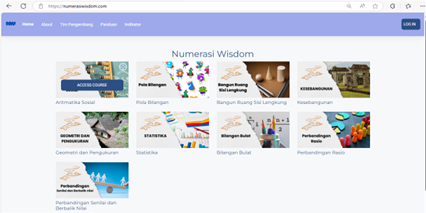
This research is motivated by the low numeracy ability and mathematical reflective thinking. The metacognitive approach trains students to understand problems, make connections, develop problem-solving strategies, and evaluate and reflect on their work. Numeracy in it is related to the context of local wisdom. This research aims to develop a numeracy website grounded in local wisdom, using a metacognition approach to improve mathematical reflective thinking skills. This research method uses DDR (Design and Development Research), which consists of identifying problems and defining the research focus, designing and developing products, implementing, evaluating, and communicating test results. The subjects of this research were 10 and 30 junior high school students. Data analysis was carried out using descriptive statistics and the normalized gain test to assess effectiveness. The instruments used were mathematical reflective thinking ability tests, education questionnaires, educational materials, media, and a student response questionnaire. The results of this study concluded that website media developed by media experts (89.5%), education (93.6%), and materials (95%) are very feasible and interesting, and student responses are very good or very positive (80.55%). This numeracy website can improve mathematical reflective thinking skills to a very high level (0.79).
##plugins.themes.bootstrap3.article.details##

This work is licensed under a Creative Commons Attribution-ShareAlike 4.0 International License.
The author is responsible for acquiring the permission(s) to reproduce any copyrighted figures, tables, data, or text that are being used in the submitted paper. Authors should note that text quotations of more than 250 words from a published or copyrighted work will require grant of permission from the original publisher to reprint. The written permission letter(s) must be submitted together with the manuscript.References
Aini, V., Hidayat, T., Kusnadi, K., Williams, C., & Hadibarata, T. (2024). Analysis numeracy literacy skills of high school students in biodiversity material based on minimum competency assessment questions. Jurnal Pendidikan IPA Indonesia, 13(1), 128–136. https://doi.org/10.15294/jpii.v13i1.49265
Aksu, N., Aksu, G., & Saracaloğlu, S. (2022). Prediction of the factors affecting PISA mathematics literacy of students from different countries by using data mining methods. lnternational Electronic Journal of Elementary Education, 14, 613–629. https://doi.org/10.26822/iejee.2022.267
Aldahmash, A. H., Alshalhoub, S. A., & Naji, M. A. (2021). Mathematics teachers’ reflective thinking: Level of understanding and implementation in their professional practices. PLoS One, 16(10), e0258149. https://doi.org/10.1371/journal.pone.0258149
Al-Duhani, F., Mohd Saat, R., & Abdullah, M. N. S. (2024). Effectiveness of web-based virtual laboratory on grade eight students’ self-regulated learning. Eurasia Journal of Mathematics, Science and Technology Education, 20(3), em2410. https://doi.org/10.29333/ejmste/14282
An, Y.-J., & Cao, L. (2014). Examining the effects of metacognitive scaffolding on students’ design problem solving and metacognitive skills in an online environment. Journal of Online Learning and Teaching, 10(4), 552–568.
Asmara, A. S., Yusuf, Y., Prawiyogi, A. G., Zonyfar, C., Alhamssyah, M. A., & Alfarid, M. N. (2026). Profiling numeracy literacy among ninth-grade students: Empirical evidence from junior secondary education. Infinity Journal, 15(1), 291–318. https://doi.org/10.22460/infinity.v15i1.p291-318
Beege, M., Scherer, D., & Weiß, E. (2023). Improving e-learning websites: the role of menu depth and metacognitive support. Frontiers in Education, 8, 1161460. https://doi.org/10.3389/feduc.2023.1161460
Cabrera, D., Cabrera, L., & Cabrera, E. (2022). The “Fish Tank” experiments: metacognitive awareness of distinctions, systems, relationships, and perspectives (DSRP) significantly increases cognitive complexity. Systems, 10(2), 29. https://doi.org/10.3390/systems10020029
Cahya, K. (2023). Development of learning media for local wisdom Pendalungan through 10 in 1 box. Educational Studies: Conference Series, 3(1), 1–11. https://doi.org/10.30872/escs.v3i1.2580
Chen, X., Li, X., Zou, D., Xie, H., & Wang, F. L. (2025). Metacognition research in education: topic modeling and bibliometrics. Educational Technology Research and Development, 73(3), 1399–1427. https://doi.org/10.1007/s11423-025-10451-8
Citrawan, I. W., Widana, I. W., Sumandya, I. W., Widana, I. N. S., Mukminin, A., Arief, H., Razak, R. A., Hadiana, D., & Meter, W. (2024). Special education teachers’ ability in literacy and numeracy assessments based on local wisdom. Jurnal Ilmiah Ilmu Terapan Universitas Jambi, 8(1), 145–157. https://doi.org/10.22437/jiituj.v8i1.32608
Craig, K., Hale, D., Grainger, C., & Stewart, M. E. (2020). Evaluating metacognitive self-reports: systematic reviews of the value of self-report in metacognitive research. Metacognition and Learning, 15(2), 155–213. https://doi.org/10.1007/s11409-020-09222-y
Damopolii, I., Nunaki, J. H., Jeni, J., Rampheri, M. B., & Ambusaidi, A. (2024). An integration of local wisdom into a problem-based student book to empower students' conservation attitudes. Participatory Educational Research, 11(1), 158–177. https://doi.org/10.17275/per.24.10.11.1
de Almeida, L. M. W., & de Castro, É. M. V. (2023). Metacognitive strategies in mathematical modelling activities: structuring an identification instrument. Journal of Research in Mathematics Education, 12(3), 210–228. https://doi.org/10.17583/redimat.12926
Duangnamol, T., Supnithi, T., Srijuntongsiri, G., & Ikeda, M. (2018). Computer-supported meta-reflective learning model via mathematical word problem learning for training metacognition. Research and Practice in Technology Enhanced Learning, 13(1), 14. https://doi.org/10.1186/s41039-018-0080-1
Ellis, T. J., & Levy, Y. (2010). A guide for novice researchers: Design and development research methods. In Proceedings of Informing Science & IT Education Conference (InSITE), (pp. 107–117).
Fauzan, A., Harisman, Y., Yerizon, Y., Suherman, S., Tasman, F., Nisa, S., Sumarwati, S., Hafizatunnisa, H., & Syaputra, H. (2024). Realistic mathematics education (RME) to improve literacy and numeracy skills of elementary school students based on teachers’ experience. Infinity Journal, 13(2), 301–316. https://doi.org/10.22460/infinity.v13i2.p301-316
Gadot, R., & Tsybulsky, D. (2025). Taxonomy of digital curation activities that promote critical thinking. Smart learning environments, 12(1), 17. https://doi.org/10.1186/s40561-025-00365-6
Haka, N. B., Pamungkas, M. F., Masya, H., Rakhmawati, I., & Hidayah, N. (2024). Desain, development, and evaluation of biology e-modules website based on local wisdom of the Baduy tribe: Strengthening Pancasila student profiles on ecosystem material. E3S Web of Conferences, 482, 05005. https://doi.org/10.1051/e3sconf/202448205005
Hake, R. R. (2002). Relationship of individual student normalized learning gains in mechanics with gender, high-school physics, and pretest scores on mathematics and spatial visualization. In Physics education research conference, (Vol. 8, pp. 1–14).
Haris, R., Duygulu, S., Syakur, R., Hafidah, A., Djatmiko, B., Maryam, A., & Indrawati, A. (2025). Enhancing ecopreneurship competency through bidan elok e-learning based on local wisdom. Aptisi Transactions on Technopreneurship (ATT), 7(2), 424–440. https://doi.org/10.34306/att.v7i2.510
Hidayat, W., Aripin, U., & Widodo, S. A. (2025). Integration of ethno-modelling and 3N: An innovative digital worksheet framework to enhance students' mathematical critical thinking skills. Infinity Journal, 14(4), 1019–1042. https://doi.org/10.22460/infinity.v14i4.p1019-1042
Hikmawati, H., Suastra, I. W., Suma, K., & Sudiatmika, A. A. I. A. R. (2024). Online lectures with local wisdom context: efforts to develop students’ higher-order thinking skills. International Journal of Evaluation and Research in Education (IJERE), 13(2), 943–951. https://doi.org/10.11591/ijere.v13i2.25744
Hourigan, T., & Murray, L. (2010). Using blogs to help language students to develop reflective learning strategies: Towards a pedagogical framework. Australasian Journal of Educational Technology, 26(2), 209–225. https://doi.org/10.14742/ajet.1091
Imran, I., Astari, Z., Imanulyaqin, M. N., Utami, P. R., & Ramadhan, I. (2025). Innovative methodology of local wisdom-based learning as a strategy for communities on the Indonesia-Malaysia border. International Journal of Learning, Teaching and Educational Research, 24(6), 415–431. https://doi.org/10.26803/ijlter.24.6.19
Indrawan, P. E., Parwati, N. N., Tegeh, I. M., & Sudatha, I. G. W. (2024). Trends in the use of augmented reality in character development within local wisdom in schools: A bibliometric study. Indian Journal of Information Sources and Services, 14(4), 7–15. https://doi.org/10.51983/ijiss-2024.14.4.02
Jbeili, I. (2012). The effect of cooperative learning with metacognitive scaffolding on mathematics conceptual understanding and procedural fluency. International Journal for Research in Education (IJRE), 32, 45–71.
Johar, R., Wahyuna, A., Maidiyah, E., Rahmayani, R. F., & Harnita, F. (2022). Development of numeracy problems with the context of herbal medicines in junior high school. Jurnal Didaktik Matematika, 9(2), 280–297. https://doi.org/10.24815/jdm.v9i2.27783
Karmila, A. D., Wiryanto, W., & Ekawati, R. (2026). The effectiveness of role playing learning in improving the numeracy skills of primary school students: A systematic literature review. Jurnal Pendidikan Indonesia Gemilang, 6(1), 21–38. https://doi.org/10.53889/jpig.v6i1.851
Laamena, C. M., & Laurens, T. (2021). Mathematical literacy ability and metacognitive characteristics of mathematics pre-service teacher. Infinity Journal, 10(2), 259–270. https://doi.org/10.22460/infinity.v10i2.p259-270
Leton, S. I., Lakapu, M., Dosinaeng, W. B. N., & Fitriani, N. (2025). Integrating local wisdoms for improving students’ mathematical literacy: The promising context in learning whole numbers. Infinity Journal, 14(2), 369–392. https://doi.org/10.22460/infinity.v14i2.p369-392
Marsia, S., Kamran, A., Mahmood Shah, S. M., Merchant, R. A., & Abbas, S. E. (2024). Exploring the content of epilepsy fellowship program websites: an analysis of information available to applicants. BMC Medical Education, 24(1), 1–9. https://doi.org/10.1186/s12909-024-05612-x
Murdiyanto, T., Wijayanti, D. A., Maula, N. F., & Sovia, A. (2023). “In-Math” as a website-based e-learning media in the endemic era. International Journal of Information and Education Technology, 13(1), 1–9. https://doi.org/10.18178/ijiet.2023.13.1.1773
Nagel, M.-T., Schäfer, S., Zlatkin-Troitschanskaia, O., Schemer, C., Maurer, M., Molerov, D., Schmidt, S., & Brückner, S. (2020). How do university students’ web search behavior, website characteristics, and the interaction of both influence students’ critical online reasoning? Frontiers in Education, 5, 565062. https://doi.org/10.3389/feduc.2020.565062
Namvar, Y., Naderi, E., Shariatmadari, A., & Seifnaraghi, M. (2009). Studying the impact of web-based learning (weblog) with a problem solving approach on student's reflective thinking. International Journal of Emerging Technologies in Learning (iJET), 4(2), 33–38. https://doi.org/10.3991/ijet.v4i2.725
Nindiasari, H., Fatah, A., Sukirwan, S., & Madadina, M. (2022). E-module interactive of minimum competency assessment: Development and understanding for mathematics teachers. Kreano, Jurnal Matematika Kreatif-Inovatif, 13(2), 339–353.
Nindiasari, H., Novaliyosi, N., & Subhan, A. (2016). Desain didaktis tahapan kemampuan dan disposisi berpikir reflektif matematis berdasarkan gaya belajar [Didactic design of stages of mathematical reflective thinking abilities and dispositions based on learning styles]. Jurnal Kependidikan, 46(2), 219–232.
Nindiasari, H., Pranata, M. F., Sukirwan, S., Sugiman, S., Fathurrohman, M., Ruhimat, A., & Yuhana, Y. (2024). The use of augmented reality to improve students' geometry concept problem-solving skills through the STEAM approach. Infinity Journal, 13(1), 119–138. https://doi.org/10.22460/infinity.v13i1.p119-138
Nindiasari, H., Yuhana, Y., Novaliyosi, N., & Sukirwan, S. (2020). Effectiveness of scaffolding-based interactive teaching materials: reflective thinking ability in prospective teacher mathematics. Journal of Physics: Conference Series, 1657(1), 012087. https://doi.org/10.1088/1742-6596/1657/1/012087
Nurazizah, S., Maharani, D. F., Sari, I. J., & Camara, J. S. (2025). Trends in computational thinking research in science education: A systematic review. Jurnal Pendidikan Indonesia Gemilang, 5(2), 126–134. https://doi.org/10.53889/jpig.v5i2.697
Nursyahidah, F., Wardono, W., Mariani, S., & Wijayanti, K. (2025). Integrating technology, ethnomathematics, and realistic mathematics education in learning statistics: A learning trajectory. Infinity Journal, 14(3), 633–654. https://doi.org/10.22460/infinity.v14i3.p633-654
Pei, T., & Suwanthep, J. (2019). Effects of web-based metacognitive listening on Chinese university EFL learners' listening comprehension and metacognitive awareness. Indonesian Journal of Applied Linguistics, 9(2), 480–492. https://doi.org/10.17509/ijal.v9i2.20246
Potgieter, E., & van der Walt, M. (2022). Metacognitive awareness and the zone of proximal intermediate phase mathematics teachers’ professional development. Eurasia Journal of Mathematics, Science and Technology Education, 18(8), em2134. https://doi.org/10.29333/ejmste/12206
Pratiwi, I. M., & Ariawan, V. A. N. (2020). Introducing local wisdom by numbering and reading. Journal of Physics: Conference Series, 1521(3), 032013. https://doi.org/10.1088/1742-6596/1521/3/032013
Purnomo, H., Sa’dijah, C., Hidayanto, E., Sisworo, S., Permadi, H., & Anwar, L. (2022). Development of instrument numeracy skills test of minimum competency assessment (MCA) in Indonesia. International Journal of Instruction, 15(3), 635–648. https://doi.org/10.29333/iji.2022.15335a
Rahmi, N., Zubainur, C. M., & Marwan, M. (2020). Students’ mathematical reflective thinking ability through scaffolding strategies. Journal of Physics: Conference Series, 1460(1), 012022. https://doi.org/10.1088/1742-6596/1460/1/012022
Rasid, N. S. M., Nasir, N. A. M., Singh, P., Han, C. T., & Sueb, R. (2022). Developing teaching guidelines of learning numeracy through game card for preschool teachers. Asian Journal of University Education, 18(4), 933–943. https://doi.org/10.24191/ajue.v18i4.20002
Ristanto, R., Lestari, P., & Miarsyah, M. (2019). Analysis of conceptual understanding of botany and metacognitive skill in pre-service biology teacher in Jakarta, Indonesia. Journal for the Education of Gifted Young Scientists, 7(2), 199–214. https://doi.org/10.17478/jegys.515978
Salido, A., & Dasari, D. (2019). The analysis of students’ reflective thinking ability viewed by students’ mathematical ability at senior high school. Journal of Physics: Conference Series, 1157(2), 022121. https://doi.org/10.1088/1742-6596/1157/2/022121
Saraswati, Y., Wiryanto, W., & Ekawati, R. (2026). Integration of realistic mathematics education (RME) and GeoGebra in elementary school geometry learning: A systematic literature review. Jurnal Pendidikan Indonesia Gemilang, 6(1), 1–20. https://doi.org/10.53889/jpig.v6i1.849
Setiyani, S., Waluya, S. B., Sukestiyarno, Y. L., Cahyono, A. N., & Santi, D. P. D. (2024). Assessing numeracy skills on flat shapes and scaffolding forms in junior high school. International Journal of Evaluation and Research in Education (IJERE), 13(1), 422–432. https://doi.org/10.11591/ijere.v13i1.25186
Shen, X., Ismail, L., & Jeyaraj, J. J. (2024). Metacognitive strategies and writing proficiency: Mediating role of critical thinking skills in online learning mode during COVID-19. Pertanika Journal of Social Sciences and Humanities, 32(4), 1619–1641. https://doi.org/10.47836/pjssh.32.4.18
Supriadi, S. (2022). Elementary school students reflection: Didactical design analysis on integer and fraction operations on mathematical concepts with Sundanese ethnomathematics learning. Pegem Journal of Education and Instruction, 12(4), 192–199. https://doi.org/10.47750/pegegog.12.04.19
Suripah, S., & Susanti, W. D. (2022). Alternative learning during a pandemic: Use of the website as a mathematics learning media for student motivation. Infinity Journal, 11(1), 17–32. https://doi.org/10.22460/infinity.v11i1.p17-32
Susperreguy, M. I., Lira, C. J., & LeFevre, J.-A. (2022). Cross-cultural comparisons of home numeracy and literacy environments: Canada, Mexico, and Chile. Education Sciences, 12(2), 62. https://doi.org/10.3390/educsci12020062
Syahfitri, J., & Muntahanah, M. (2024). The effectiveness of local wisdom-based interactive digital module on students’ critical thinking disposition. International Journal of Evaluation and Research in Education (IJERE), 13(4), 2170–2177. https://doi.org/10.11591/ijere.v13i4.28256
Syamsuddin, A., Juniati, D., & Siswono, T. Y. E. (2020). Understanding the problem solving strategy based on cognitive style as a tool to investigate reflective thinking process of prospective teacher. Universal Journal of Educational Research, 8(6), 2614–2620. https://doi.org/10.13189/ujer.2020.080644
Tao, A., Huang, Y., Shinohara, Y., Caylor, M. L., Pashikanti, S., & Xu, D. (2019). ezCADD: A rapid 2D/3D visualization-enabled web modeling environment for democratizing computer-aided drug design. Journal of Chemical Information and Modeling, 59(1), 18–24. https://doi.org/10.1021/acs.jcim.8b00633
Tegeh, I. M., Astawan, I. G., Sudiana, I. K., & Kristiantari, M. G. R. (2021). Murder learning model assisted by metacognitive scaffolding to improve students’ scientific literacy and numeracy skills through science studies in elementary schools. Jurnal Pendidikan IPA Indonesia, 10(4), 618–626. https://doi.org/10.15294/jpii.v10i4.32926
Thahir, M., Roza, Y., & Murni, A. (2020). Website design of capita selekta mathematics course for mathematics education students. Journal of Physics: Conference Series, 1470(1), 012092. https://doi.org/10.1088/1742-6596/1470/1/012092
Thao, T. T. P., Thai, L. D., Thanh, H. T., Tran, T., Trinh, L. T. T., & Vuong, Q.-H. (2019). Mobile learning for high-school mathematics as a path to better sustainability in a fast-changing society: an exploratory study from Vietnam. Problems and Perspectives in Management, 17(2), 392–403. https://doi.org/10.21511/ppm.17(2).2019.30
Utari, R. S., Putri, R. I. I., Zulkardi, Z., & Hapizah, H. (2025). Supporting statistical literacy skills for prospective teachers: A learning trajectory used South Sumatra local wisdom context through hybrid learning. Infinity Journal, 14(3), 711–732. https://doi.org/10.22460/infinity.v14i3.p711-732
Wals, S. F., & Wichary, S. (2023). Under pressure: Cognitive effort during website-based task performance is associated with pupil size, visual exploration, and users’ intention to recommend. International Journal of Human–Computer Interaction, 39(18), 3504–3515. https://doi.org/10.1080/10447318.2022.2098576
Wijaya, T. T., Hidayat, W., Hermita, N., Alim, J. A., & Talib, C. A. (2024). Exploring contributing factors to PISA 2022 mathematics achievement: Insights from Indonesian teachers. Infinity Journal, 13(1), 139–156. https://doi.org/10.22460/infinity.v13i1.p139-156