
Enhancing junior high school students’ numeracy through differentiated contextual worksheets
##plugins.themes.bootstrap3.article.sidebar##
##plugins.themes.bootstrap3.article.main##
Abstract
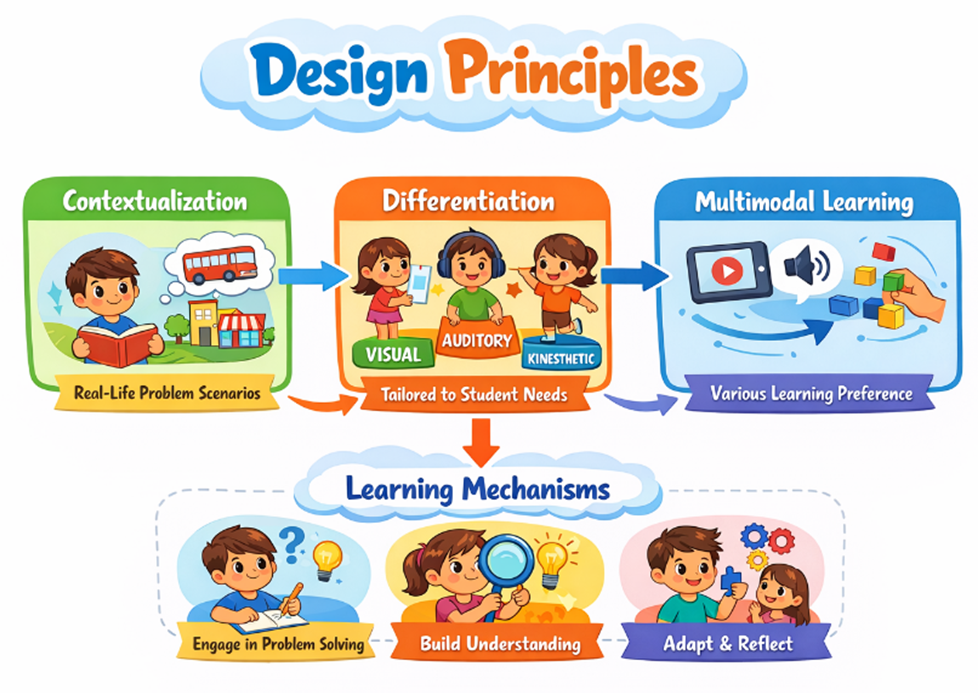
Improving students’ numeracy requires learning that is meaningful and closely connected to real-life contexts. Currently, most materials lack a differentiated numeracy approach, limiting their ability to support diverse student needs effectively. This study aims to develop contextual worksheets embedded with numeracy through a differentiated approach for junior high school students. The research employed a Research and Development (R&D) approach, adopting the ADDIE model, which comprises five stages: Analysis, Design, Development, Implementation, and Evaluation. The study involved 39 eighth-grade students from a public junior high school in Cirebon. The developed product comprises three differentiated worksheet versions tailored to students’ learning styles, visual, auditory, and kinesthetic, with numeracy activities linked to real-life contexts. Validation results from five expert validators indicated that the developed contextual worksheets achieved a very high level of validity, with an average score of 97.3% (categorized as very valid) across the content, presentation, and appearance aspects. The test instrument used to measure numeracy improvement also demonstrated high validity, scoring 96.4% (very valid). The trial results showed an average N-Gain of 0.51 (moderate), indicating an improvement in students’ numeracy skills after using the differentiated contextual worksheets. Therefore, the developed contextual worksheets are considered valid, practical, and feasible for use in mathematics learning within the framework of the Merdeka Curriculum.
##plugins.themes.bootstrap3.article.details##

This work is licensed under a Creative Commons Attribution-ShareAlike 4.0 International License.
The author is responsible for acquiring the permission(s) to reproduce any copyrighted figures, tables, data, or text that are being used in the submitted paper. Authors should note that text quotations of more than 250 words from a published or copyrighted work will require grant of permission from the original publisher to reprint. The written permission letter(s) must be submitted together with the manuscript.References
Amalia, R. (2023). Memahami keragaman siswa danpemenuhan kurikulum: Refleksi konteks pembelajaran berdifferensiasi di sekolah ppl [Understanding student diversity and curriculum fulfillment: Reflections on the context of differentiated learning in PPL schools]. Primary, 2(5), 267–273.
Asmara, A. S., Yusuf, Y., Prawiyogi, A. G., Zonyfar, C., Alhamssyah, M. A., & Alfarid, M. N. (2026). Profiling numeracy literacy among ninth-grade students: Empirical evidence from junior secondary education. Infinity Journal, 15(1), 291–318. https://doi.org/10.22460/infinity.v15i1.p291-318
Cahya, I. C., Susanto, S., Safrida, L. N., Yudianto, E., & Wihardjo, E. (2024). Pengembangan e-LKPD interaktif berbasis liveworksheets dalam pembelajaran berdiferensiasi pada materi limas fase D [Development of interactive e-LKPD based on liveworksheets in differentiated learning on pyramid material phase D]. Jurnal Tadris Matematika, 7(2), 251–268. https://doi.org/10.21274/jtm.2024.7.2.251-268
Callejo, M. L., & Zapatera, A. (2017). Prospective primary teachers’ noticing of students’ understanding of pattern generalization. Journal of Mathematics Teacher Education, 20(4), 309–333. https://doi.org/10.1007/s10857-016-9343-1
Cuevas, J. (2015). Is learning styles-based instruction effective? A comprehensive analysis of recent research on learning styles. Theory and Research in Education, 13(3), 308–333. https://doi.org/10.1177/1477878515606621
Demirci-Ünal, Z., & Öztürk, G. (2025). Is need-based action possible for each child?: Preschool teachers’ differentiated instruction within multicultural classrooms. Early Childhood Education Journal, 53(7), 2699–2718. https://doi.org/10.1007/s10643-024-01753-2
Devaki, V. (2025). Adaptive teaching techniques for varied learning styles in inclusive English language settings. Turkish Academic Research Review - Türk Akademik Araştırmalar Dergisi [TARR], 10(1), 1–11. https://doi.org/10.30622/tarr.1501292
Dey, B., & Panda, B. N. (2024). Understanding the learning style preferences of ODL students using VARK model: Implications for individualized pedagogy and student success. Asian Journal of Education and Social Studies, 50(5), 323–331. https://doi.org/10.9734/ajess/2024/v50i51365
Dick, W. (1996). The dick and carey model: Will it survive the decade? Educational Technology Research and Development, 44(3), 55–63. https://doi.org/10.1007/BF02300425
Dole, S., & Geiger, V. (2020). Numeracy across the curriculum: Research-based strategies for enhancing teaching and learning. Routledge.
El-Sabagh, H. A. (2021). Adaptive e-learning environment based on learning styles and its impact on development students' engagement. International Journal of Educational Technology in Higher Education, 18(1), 53. https://doi.org/10.1186/s41239-021-00289-4
Entwistle, N. (2021). Improving teaching through research on student learning. In V. Various (Ed.), Routledge library editions: Higher education (pp. 73–112). Routledge.
Firman, F., Baedhowi, B., & Murtini, W. (2018). The effectiveness of the scientific approach to improve student learning outcomes. International Journal of Active Learning, 3(2), 86–91.
Geiger, V., Goos, M., & Forgasz, H. (2015). A rich interpretation of numeracy for the 21st century: a survey of the state of the field. Zdm, 47(4), 531–548. https://doi.org/10.1007/s11858-015-0708-1
Gheyssens, E., Coubergs, C., Griful-Freixenet, J., Engels, N., & Struyven, K. (2022). Differentiated instruction: the diversity of teachers’ philosophy and praxis to adapt teaching to students’ interests, readiness and learning profiles. International Journal of Inclusive Education, 26(14), 1383–1400. https://doi.org/10.1080/13603116.2020.1812739
Hake, R. R. (1999). Analyzing change/gain scores. Measurement and Reasearch Methodology, 1(4), 48–56.
Hannula, M. S. (2012). Exploring new dimensions of mathematics-related affect: embodied and social theories. Research in Mathematics Education, 14(2), 137–161. https://doi.org/10.1080/14794802.2012.694281
Hasudungan, A. N. (2022). Pembelajaran contextual teaching learning (CTL) pada masa pandemi COVID-19: Sebuah tinjauan [Contextual teaching learning (CTL) during the COVID-19 pandemic: A review]. Jurnal DinamikA, 3(2), 112–126. https://doi.org/10.18326/dinamika.v3i2.112-126
Hidayat, W., & Aripin, U. (2023). How to develop an E-LKPD with a scientific approach to achieving students' mathematical communication abilities? Infinity Journal, 12(1), 85–100. https://doi.org/10.22460/infinity.v12i1.p85-100
Hidayat, W., Aripin, U., & Widodo, S. A. (2025). Integration of ethno-modelling and 3N: An innovative digital worksheet framework to enhance students' mathematical critical thinking skills. Infinity Journal, 14(4), 1019–1042. https://doi.org/10.22460/infinity.v14i4.p1019-1042
Hidayat, Z., Syamsuddin, A., & Mukhlis, M. (2025). The numeracy literacy process of fifth-grade elementary school students in solving word problems. Journal of Educational Sciences, 9(4), 2409–2418.
Irfan, M., Nilawati, A. R., Sulistyowati, F., & Sukiyanto, S. (2023). Analisis kemampuan numerasi siswa dalam menyelesaikan masalah pada konteks budaya [Analysis of students' numeracy abilities in solving problems in a cultural context]. JKPM (Jurnal Kajian Pendidikan Matematika), 8(2). https://doi.org/10.30998/jkpm.v8i2.15686
Ketterlin-Geller, L. R., & Chard, D. J. (2011). Algebra readiness for students with learning difficulties in grades 4–8: Support through the study of number. Australian Journal of Learning Difficulties, 16(1), 65–78. https://doi.org/10.1080/19404158.2011.563478
Lawson, M. J., Van Deur, P., Scott, W., Stephenson, H., Kang, S., Wyra, M., Darmawan, I., Vosniadou, S., Murdoch, C., White, E., & Graham, L. (2023). The levels of cognitive engagement of lesson tasks designed by teacher education students and their use of knowledge of self-regulated learning in explanations for task design. Teaching and Teacher Education, 125, 104043. https://doi.org/10.1016/j.tate.2023.104043
Linder, K. E., & Kelly, K. (2024). Writing course goals and learning objectives. In K. E. Linder & K. Kelly (Eds.), The blended course design workbook (pp. 42–55). Routledge.
Marhami, M., Juandi, D., & Dasari, D. (2024). Indonesian students’ numeracy skills based on PISA mathematical problems in secondary school: A meta-synthesis. Jurnal Pendidikan MIPA, 25(1), 14–26. https://doi.org/10.23960/jpmipa/v25i1.pp14-26
Matriano, E. A. (2020). Ensuring student-centered, constructivist and project-based experiential learning applying the exploration, research, interaction and ereation (ERIC) learning model. International Online Journal of Education and Teaching, 7(1), 214–227.
Mavrikis, M., Rummel, N., Wiedmann, M., Loibl, K., & Holmes, W. (2022). Combining exploratory learning with structured practice educational technologies to foster both conceptual and procedural fractions knowledge. Educational Technology Research and Development, 70(3), 691–712. https://doi.org/10.1007/s11423-022-10104-0
Nawali, J., Ivtari Savika, H., Kharismatul Mufidah, I., & Susilawati, S. (2024). Pengembangan media pembelajaran di MI dan SD [Development of learning media in MI and SD]. CAHAYA: Journal of Research on Science Education, 2(1), 37–49. https://doi.org/10.70115/cahaya.v2i1.133
OECD. (2019). PISA 2018 Results (Volume I): What students know and can do. OECD Publishing.
Pasira, I. (2022). Assessing the effectiveness of differentiated instruction strategies in diverse classrooms. Journal of Education Review Provision, 2(1), 28–31. https://doi.org/10.55885/jerp.v2i1.151
Polotskaia, E., Fellus, O. O., Cavalcante, A., & Savard, A. (2022). Students’ problem solving and transitioning from numerical to relational thinking. Canadian Journal of Science, Mathematics and Technology Education, 22(2), 341–364. https://doi.org/10.1007/s42330-022-00218-1
Putri, R. I. I., Zulkardi, Z., Sari, N., Sagita, L., Siligar, E. I. P., & Sukma, Y. (2025). Learning numeracy using new Pempek mathematics. Journal on Mathematics Education, 16(1), 1–22. https://doi.org/10.22342/jme.v16i1.pp1-22
Rau, M. A., & Matthews, P. G. (2017). How to make ‘more’ better? Principles for effective use of multiple representations to enhance students’ learning about fractions. Zdm, 49(4), 531–544. https://doi.org/10.1007/s11858-017-0846-8
Reyes, J., Insorio, A. O., Ingreso, M. L. V., Hilario, F. F., & Gutierrez, C. R. (2019). Conception and application of contextualization in mathematics education. International Journal of Educational Studies in Mathematics, 6(1), 1–18.
Riduwan, R. (2010). Belajar mudah peneliti untuk guru-karyawan dan peneliti pemula [Easy learning for teachers-employees and novice researchers]. Alfabeta.
Rosita, C. D., Setiyani, S., Asmara, A. S., Sumarwati, S., & Suprayo, T. (2026). Mathematical thinking processes based on decision-making types in Grade VIII numeracy: Foundations for differentiated instruction in Geometry. Journal on Mathematics Education, 17(1), 1–26. https://doi.org/10.22342/jme.v17i1.pp1-26
Rosita, C. D., Setiyani, S., & Cartini, N. (2025). Integrated problem based learning differentiated instruction: An effort to improve students' literacy numeracy skills. IndoMath: Indonesia Mathematics Education, 8(1), 33–43.
Safitri, S. Y., Supriyono, S., & Astuti, E. P. (2023). E-modul matematika berbasis kontekstual untuk mengembangkan kemampuan numerasi siswa SMP [Contextual-based mathematics e-module to develop junior high school students' numeracy skills]. Gammath : Jurnal Ilmiah Program Studi Pendidikan Matematika, 8(1), 47–54. https://doi.org/10.32528/gammath.v8i1.275
Schoenherr, J., & Schukajlow, S. (2024). Characterizing external visualization in mathematics education research: a scoping review. ZDM – Mathematics Education, 56(1), 73–85. https://doi.org/10.1007/s11858-023-01494-3
Setioningsih, D. K., Wardani, I. S., & Prayogo, P. (2025). Exploration of the role of real context in developing mathematical understanding through the realistic mathematics education approach. Journal La Edusci, 6(6), 1123–1137.
Sewagegn, A. A. (2020). Learning objective and assessment linkage: Its contribution to meaningful student learning. Universal Journal of Educational Research, 8(11), 5044–5052. https://doi.org/10.13189/ujer.2020.081104
Sfard, A. (2020). Discursive approaches to learning mathematics. In S. Lerman (Ed.), Encyclopedia of mathematics education (pp. 234–237). Springer. https://doi.org/10.1007/978-3-030-15789-0_52
She, H. C., Stacey, K., & Schmidt, W. H. (2018). Science and mathematics literacy: PISA for better school education. International Journal of Science and Mathematics Education, 16(1), 1–5. https://doi.org/10.1007/s10763-018-9911-1
Sheromova, T. S., Khuziakhmetov, A. N., Kazinets, V. A., Sizova, Z. M., Buslaev, S. I., & Borodianskaia, E. A. (2020). Learning styles and development of cognitive skills in mathematics learning. Eurasia Journal of Mathematics, Science and Technology Education, 16(11), em1895. https://doi.org/10.29333/ejmste/8538
Tomlinson, C. A. (2014). The differentiated classroom: Responding to the needs of all learners. ASCD.
Tomlinson, C. A. (2017). How to differentiate instruction in academically diverse classrooms. ASCD.
Tomlinson, C. A., & Jarvis, J. M. (2023). Differentiation: Making curriculum work for all students through responsive planning & instruction. In J. S. Renzulli, E. J. Gubbins, K. S. McMillen, R. D. Eckert, & C. A. Little (Eds.), Systems and models for developing programs for the gifted and talented (pp. 599–628). Routledge.
Van den Heuvel-Panhuizen, M., & Drijvers, P. (2020). Realistic mathematics education. In S. Lerman (Ed.), Encyclopedia of mathematics education (pp. 713–717). Springer International Publishing. https://doi.org/10.1007/978-3-030-15789-0_170
Wijaya, T. T., Hidayat, W., Hermita, N., Alim, J. A., & Talib, C. A. (2024). Exploring contributing factors to PISA 2022 mathematics achievement: Insights from Indonesian teachers. Infinity Journal, 13(1), 139–156. https://doi.org/10.22460/infinity.v13i1.p139-156
Winarni, S., Kamid, K., Marzal, J., & Asrial, A. (2025). Numeracy skill development in prospective mathematics teachers: Challenges and opportunities in real-world contexts. Journal on Mathematics Education, 16(1), 91–110. https://doi.org/10.22342/jme.v16i1.pp91-110
Yang, T.-C., Chen, M. C., & Chen, S. Y. (2018). The influences of self-regulated learning support and prior knowledge on improving learning performance. Computers & Education, 126, 37–52. https://doi.org/10.1016/j.compedu.2018.06.025