
Predicting mathematics well-being in secondary school students: An integrated model of self-determination and social support in Indonesia
##plugins.themes.bootstrap3.article.sidebar##
##plugins.themes.bootstrap3.article.main##
Abstract
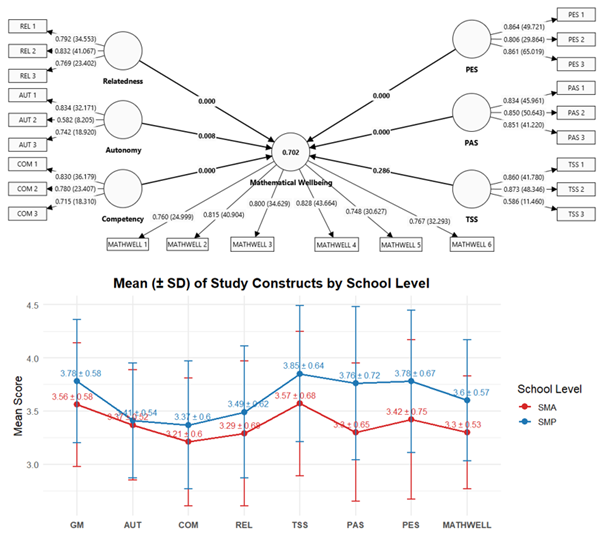
Improving students’ mathematical wellbeing is important because it supports their positive feelings toward mathematics and contributes to better learning outcomes. However, limited research has explored which factors influence mathematical wellbeing from the students’ own perspective. This study aims to address this gap by examining both external and internal predictors, drawing on Self-Determination Theory and Social Support Theory. Data were collected from 449 secondary school students in Indonesia, and Structural Equation Modelling was conducted using SmartPLS. The findings show that five out of six proposed hypotheses were supported. Specifically, autonomy, competence, and relatedness, as well as parent support and peer emotional support, were found to have significant positive effects on students’ mathematical wellbeing, whereas teacher social support did not show a significant direct effect. The structural model demonstrated strong explanatory power, with the predictors jointly explaining 70.2% of the variance in mathematical wellbeing. These findings suggest that enhancing students’ mathematical wellbeing requires attention to both basic psychological needs and social support systems, particularly support from parents and peers. Interventions aimed at fostering autonomy, competence, and relatedness may be effective strategies for promoting positive experiences in mathematics learning.
##plugins.themes.bootstrap3.article.details##

This work is licensed under a Creative Commons Attribution-ShareAlike 4.0 International License.
The author is responsible for acquiring the permission(s) to reproduce any copyrighted figures, tables, data, or text that are being used in the submitted paper. Authors should note that text quotations of more than 250 words from a published or copyrighted work will require grant of permission from the original publisher to reprint. The written permission letter(s) must be submitted together with the manuscript.References
Acar, I. H., Altundal, M. N., Kırmızıtaş, M., & Kırbaşoğlu, K. (2022). Can you see me at my worst? A latent Profile analysis of students and teachers’ perceptions of student behavior problems. Current Psychology, 42(32), 28107–28118. https://doi.org/10.1007/s12144-022-03888-0
Bulotsky-Shearer, R. J., Bell, E. R., Carter, T. M., & Dietrich, S. L. R. (2014). Peer play interactions and learning for low-income preschool children: The moderating role of classroom quality. Early Education and Development, 25(6), 815–840. https://doi.org/10.1080/10409289.2014.864214
Clarkson, P., Bishop, A., & Seah, W. T. (2010). Mathematics education and student values: The cultivation of mathematical wellbeing. In T. Lovat, R. Toomey, & N. Clement (Eds.), International research handbook on values education and student wellbeing (pp. 111–135). Springer Netherlands. https://doi.org/10.1007/978-90-481-8675-4_7
Cohen, S., & Wills, T. A. (1985). Stress, social support, and the buffering hypothesis. Psychological bulletin, 98(2), 310–357. https://doi.org/10.1037/0033-2909.98.2.310
Cunningham, C. E., & Siegel, L. S. (1987). Peer interactions of normal and attention-deficit-disordered boys during free-play, cooperative task, and simulated classroom situations. Journal of Abnormal Child Psychology, 15(2), 247–268. https://doi.org/10.1007/bf00916353
Delima, N., Kusuma, D. A., & Paulus, E. (2024). The students' mathematics self-regulated learning and mathematics anxiety based on the use of chat GPT, music, study program, and academic achievement. Infinity Journal, 13(2), 349–362. https://doi.org/10.22460/infinity.v13i2.p349-362
Diponegoro, A. M., Khalil, I. A., & Prahmana, R. C. I. (2024). When religion meets mathematics: From mathematical anxiety to mathematical well-being for minority group student. Infinity Journal, 13(2), 413–440. https://doi.org/10.22460/infinity.v13i2.p413-440
Fadiji, A. W., & Reddy, V. (2023). Well-being and mathematics achievement: What is the role of gender, instructional clarity, and parental involvement? Frontiers in psychology, 13, 1044261. https://doi.org/10.3389/fpsyg.2022.1044261
Fan, L. (2024). Effects of perceived teacher support on online language learners’ engagement. Heliyon, 10(15), e35679. https://doi.org/10.1016/j.heliyon.2024.e35679
Fendrik, M., Prihandoko, Y., Wijaya, T. T., & Ahmad, N. J. (2024). Analysis of elementary school student attitudes to mathematics, accelerated learning cycle (ALC) and mathematical questions. Journal of Teaching and Learning in Elementary Education (JTLEE), 7(1), 45–58.
Fornell, C., & Larcker, D. F. (1981). Evaluating structural equation models with unobservable variables and measurement error. Journal of Marketing Research, 18(1), 39–50. https://doi.org/10.1177/002224378101800104
Frenzel, A. C., Pekrun, R., & Goetz, T. (2007). Perceived learning environment and students' emotional experiences: A multilevel analysis of mathematics classrooms. Learning and Instruction, 17(5), 478–493. https://doi.org/10.1016/j.learninstruc.2007.09.001
Gao, B., Wijaya, T. T., He, Y., Ma, H., & Wu, L. (2025). What factors affect student procrastination on mathematics homework: Self-determination theory perspective. Acta Psychologica, 256, 105020. https://doi.org/10.1016/j.actpsy.2025.105020
Goldin, G. A., Epstein, Y. M., Schorr, R. Y., & Warner, L. B. (2011). Beliefs and engagement structures: behind the affective dimension of mathematical learning. Zdm, 43(4), 547–560. https://doi.org/10.1007/s11858-011-0348-z
Haas, B., Lavicza, Z., Houghton, T., & Kreis, Y. (2022). Evaluating technology-enhanced, STEAM-based remote teaching with parental support in Luxembourgish early childhood education. Frontiers in Education, 7, 872479. https://doi.org/10.3389/feduc.2022.872479
Hair, J. F., Risher, J. J., Sarstedt, M., & Ringle, C. M. (2019). When to use and how to report the results of PLS-SEM. European Business Review, 31(1), 2–24. https://doi.org/10.1108/ebr-11-2018-0203
He, Y., Wijaya, T. T., Habibi, A., chen, H., & Gao, M. (2025). Exploring the relationship between teacher and parent support and students’ noncognitive outcomes via Latent Profile Analysis. Humanities and Social Sciences Communications, 12(1), 105. https://doi.org/10.1057/s41599-025-04422-w
Hidayati, A. P., & Shodikin, A. (2025). Senior high school students’ difficulties in solving HOTS probability problem and their scaffolding based on learning styles. Journal of the Indonesian Mathematics Education Society, 3(1), 19–32.
Hill, J. L., & Hunter, J. (2024). Diverse students’ mathematical wellbeing. New Zealand Journal of Educational Studies, 59(1), 211–234. https://doi.org/10.1007/s40841-024-00318-6
Hoferichter, F., Kulakow, S., & Hufenbach, M. C. (2021). Support from parents, peers, and teachers is differently associated with middle school students’ well-being. Frontiers in psychology, 12, 758226. https://doi.org/10.3389/fpsyg.2021.758226
Hunter, J., & Hill, J. L. (2024). Exploring mathematical wellbeing across cultures: insights from diverse students. Mathematics Education Research Journal, 37(3), 529–556. https://doi.org/10.1007/s13394-024-00500-5
Hutajulu, M., Wijaya, T. T., & Hidayat, W. (2019). The effect of mathematical disposition and learning motivation on problem solving: An analysis. Infinity Journal, 8(2), 229–238. https://doi.org/10.22460/infinity.v8i2.p229-238
Jiang, P., Wijaya, T. T., Mailizar, M., Zulfah, Z., & Astuti, A. (2022). How micro-lectures improve learning satisfaction and achievement: A combination of ECM and extension of TAM models. Mathematics, 10(19), 3430. https://doi.org/10.3390/math10193430
Jitendra, A. K. (2019). Using schema-based instruction to improve students’ mathematical word problem solving performance. In A. Fritz, V. G. Haase, & P. Räsänen (Eds.), International handbook of mathematical learning difficulties (pp. 595–609). Springer. https://doi.org/10.1007/978-3-319-97148-3_35
Kusmaryono, I., Basir, M. A., & Saputro, B. A. (2020). Ontological misconception in mathematics teaching in elementary schools. Infinity Journal, 9(1), 15–30. https://doi.org/10.22460/infinity.v9i1.p15-30
Listiawati, E., Juniati, D., & Ekawati, R. (2025). Understanding mathematics prospective teachers' comprehension of function derivatives based on APOS theory: Insights from low mathematics anxiety levels. Infinity Journal, 14(2), 483–512. https://doi.org/10.22460/infinity.v14i2.p483-512
Liu, G. X. Y., & Helwig, C. C. (2022). Autonomy, social inequality, and support in Chinese urban and rural adolescents’ reasoning about the Chinese college entrance examination (Gaokao). Journal of Adolescent Research, 37(5), 639–671. https://doi.org/10.1177/0743558420914082
Mata, M. d. L., Monteiro, V., & Peixoto, F. (2012). Attitudes towards mathematics: Effects of individual, motivational, and social support factors. Child Development Research, 1–10. https://doi.org/10.1155/2012/876028
Mei-Ju, C., Chen-Hsin, Y., & Pin-Chen, H. (2014). The beauty of character education on preschool children's parent-child relationship. Procedia - Social and Behavioral Sciences, 143, 527–533. https://doi.org/10.1016/j.sbspro.2014.07.431
Morales-García, W. C., Sairitupa-Sanchez, L. Z., Morales-García, S. B., & Morales-García, M. (2024). Development and validation of a scale for dependence on artificial intelligence in university students. Frontiers in Education, 9, 1323898. https://doi.org/10.3389/feduc.2024.1323898
Murtafiah, W., Lestari, N. D. S., Yahya, F. H., Apriandi, D., & Suprapto, E. (2023). How do students' decision-making ability in solving open-ended problems? Infinity Journal, 12(1), 133–150. https://doi.org/10.22460/infinity.v12i1.p133-150
Niemiec, C. P., & Ryan, R. M. (2009). Autonomy, competence, and relatedness in the classroom. Theory and Research in Education, 7(2), 133–144. https://doi.org/10.1177/1477878509104318
OECD. (2019). Programme for international student assessment (PISA) results from PISA 2018. OECD.
Pan, Y., Zhong, J., Hill, J., L., & Seah, W. T. (2022). Values which facilitate mathematical wellbeing of Chinese primary school students: A preliminary study. In Twelfth Congress of the European Society for Research in Mathematics Education, Bozen-Bolzano, Italy (pp. hal–03745622). https://hal.science/hal-03745622
Prahmana, R. C. I., Sutanti, T., & Diponegoro, A. M. (2021). Matematička tjeskoba i faktori utjecaja među učenicima niže srednje škole u Yogyakarti u Indoneziji [Mathematics anxiety and the influencing factors among junior high school students in Yogyakarta, Indonesia]. Croatian Journal of Education - Hrvatski časopis za odgoj i obrazovanje, 23(2), 343–369. https://doi.org/10.15516/cje.v23i2.3890
Pramuditya, S. A., Widiyasari, R., & Fitriadi, P. (2025). Enhancing 3D geometry learning: A differentiated educational game approach. Infinity Journal, 14(4), 1043–1064. https://doi.org/10.22460/infinity.v14i4.p1043-1064
Riegle‐Crumb, C., Moore, C., & Buontempo, J. (2017). Shifting STEM stereotypes? Considering the role of peer and teacher gender. Journal of Research on Adolescence, 27(3), 492–505. https://doi.org/10.1111/jora.12289
Ryan, R. M., & Deci, E. L. (2000). Intrinsic and extrinsic motivations: Classic definitions and new directions. Contemporary Educational Psychology, 25(1), 54–67. https://doi.org/10.1006/ceps.1999.1020
Šimunović, M., & Babarović, T. (2020). The role of parents’ beliefs in students’ motivation, achievement, and choices in the STEM domain: A review and directions for future research. Social Psychology of Education, 23(3), 701–719. https://doi.org/10.1007/s11218-020-09555-1
Torres-Peña, R. C., Peña-González, D., Lara-Orozco, J. L., Ariza, E. A., & Vergara, D. (2025). Enhancing numerical thinking through problem solving: A teaching experience for third-grade mathematics. Education Sciences, 15(6), 667. https://doi.org/10.3390/educsci15060667
Videla, R., Aguayo, C., & Veloz, T. (2021). From STEM to STEAM: An enactive and ecological continuum. Frontiers in Education, 6, 709560. https://doi.org/10.3389/feduc.2021.709560
Virtanen, T. E., Vaaland, G. S., & Ertesvåg, S. K. (2019). Associations between observed patterns of classroom interactions and teacher wellbeing in lower secondary school. Teaching and Teacher Education, 77, 240–252. https://doi.org/10.1016/j.tate.2018.10.013
Wang, F., Wijaya, T. T., Habibi, A., & Liu, Y. (2022). Predictors influencing urban and rural area students to use tablet computers as learning tools: Combination of UTAUT and TTF models. Sustainability, 14(21), 13965. https://doi.org/10.3390/su142113965
Ware, P., & Kessler, G. (2016). Telecollaboration in the secondary language classroom: case study of adolescent interaction and pedagogical integration. Computer Assisted Language Learning, 29(3), 427–450. https://doi.org/10.1080/09588221.2014.961481
Wijaya, T. T., Cao, Y., Bernard, M., Rahmadi, I. F., Lavicza, Z., & Surjono, H. D. (2022). Factors influencing microgame adoption among secondary school mathematics teachers supported by structural equation modelling-based research. Frontiers in psychology, 13, 952549. https://doi.org/10.3389/fpsyg.2022.952549
Wijaya, T. T., Cao, Y., & Li, X. (2025). The impact of digital mathematics textbooks on teacher-student interaction: Evidence from behavioral sequence analysis. International Journal of Human–Computer Interaction, 41(15), 9450–9465. https://doi.org/10.1080/10447318.2024.2426033
Wijaya, T. T., Hidayat, W., Hermita, N., Alim, J. A., & Talib, C. A. (2024). Exploring contributing factors to PISA 2022 mathematics achievement: Insights from Indonesian teachers. Infinity Journal, 13(1), 139–156. https://doi.org/10.22460/infinity.v13i1.p139-156
Wijaya, T. T., Rahmadi, I. F., Chotimah, S., Jailani, J., & Wutsqa, D. U. (2022). A case study of factors that affect secondary school mathematics achievement: Teacher-parent support, stress levels, and students’ well-being. International Journal of Environmental Research and Public Health, 19(23), 16247. https://doi.org/10.3390/ijerph192316247
Yeigh, T., Willis, R., James, S., Lake, W., Lynch, D., Peddell, L., Knight, B., Lee, M., & Samojlowicz, D. (2023). Teacher of mathematics identity as a predictor of teacher wellbeing. The Australian Educational Researcher, 50(5), 1403–1420. https://doi.org/10.1007/s13384-022-00553-0
Zhou, Y., Wijaya, T. T., & Gao, Y. (2020). Investigation on the attitude of mathematics education students towards learning mathematics in Guilin. Kalamatika: Jurnal Pendidikan Matematika, 5(2), 93–102. https://doi.org/10.22236/kalamatika.vol5no2.2020pp93-102